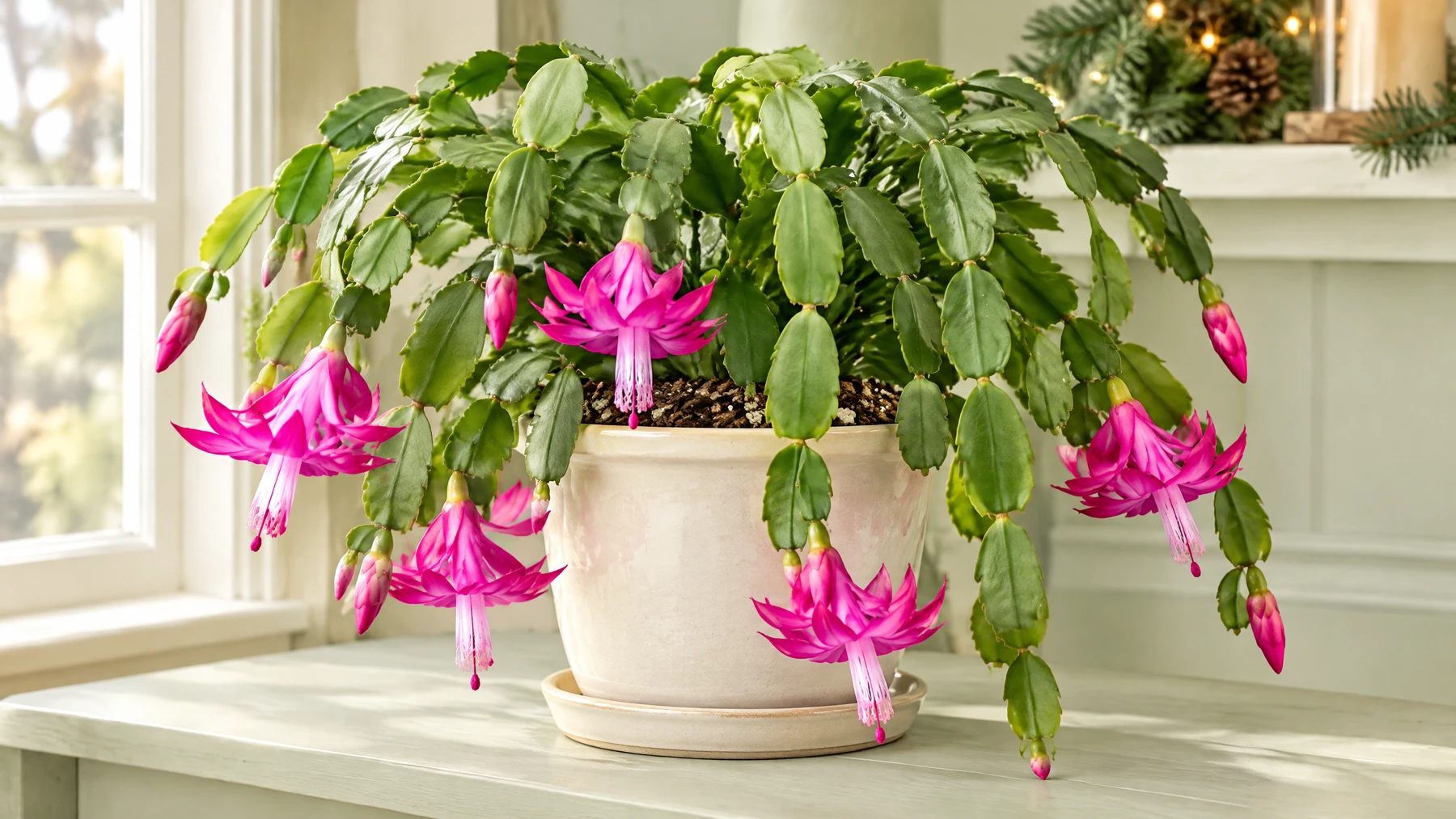
Thanksgiving cactus or Christmas cactus? Compare stem shapes, bloom timing, and care tips to choose a holiday shelf plant and protect its buds.
Informational Purposes Only
The content published on this blog — including plant care advice, disease identification, treatment recommendations, and lighting or fertilizer guidance — is intended for general informational and educational purposes only. It is not a substitute for advice from a qualified horticulturist, botanist, or plant care professional.
Some articles may incorporate AI-assisted analysis. While every effort is made to ensure accuracy, Botanical Wiz makes no warranties regarding the completeness or suitability of any information for your specific plant or environment. Always use your own judgment, and consult a plant specialist when in doubt. Botanical Wiz is not liable for any loss or damage arising from reliance on content found on this site. See our full Terms of Use and Privacy Policy.
Botanical Wiz Offshoots · Prepared with Penny, an AI writing assistant; edited by Botanical Wiz.

The illustrations in this article are AI-generated to show typical holiday-cactus traits and care settings. They are not photographs of identified specimens or definitive identification guides.
Choosing between a Thanksgiving cactus and a Christmas cactus can feel like a holiday quiz, especially when the plant tags look interchangeable. Both can bring beautiful flowers to a holiday shelf, but they are not quite the same plant—and neither should be confused with an Easter cactus.
The best choice depends on the look you enjoy, when you hope to see flowers, and the plant's condition when you bring it home. A close look at the stems is a useful starting point. Just leave room for hybrids, which do not always fit a tidy label.
Thanksgiving cactus vs. Christmas cactus: the quick difference
The flat, leaf-like pieces are actually stem segments, not leaves. Their edges offer one of the most useful clues for telling holiday cacti apart.
- Thanksgiving cactus — Schlumbergera truncata: Look for pointed, tooth- or claw-like projections along the stem edges. Its flowers are elongated and tubular-looking, and it often blooms in November into December.
- Christmas cactus — commonly Schlumbergera × buckleyi: Look for rounded, scalloped stem edges rather than sharp points. Its flowers are also elongated and tubular-looking, with flowering usually later, around December into winter.
- Easter cactus — Rhipsalidopsis gaertneri: Look for rounded segments, sometimes with small bristles, and more open, star-shaped flowers. It usually flowers in spring.
These are typical traits, not a guarantee for every plant. Holiday cactus hybrids can have intermediate stem shapes, and many plants sold as “Christmas cactus” are Thanksgiving types or hybrids. Bloom timing is another clue, but growers can adjust flowering through light and temperature.
Check several mature stem segments, not just the tag or one flower. If the traits are mixed, “holiday cactus” may be the most honest identification until you have better evidence. A generic photo cannot confirm a particular cultivar.
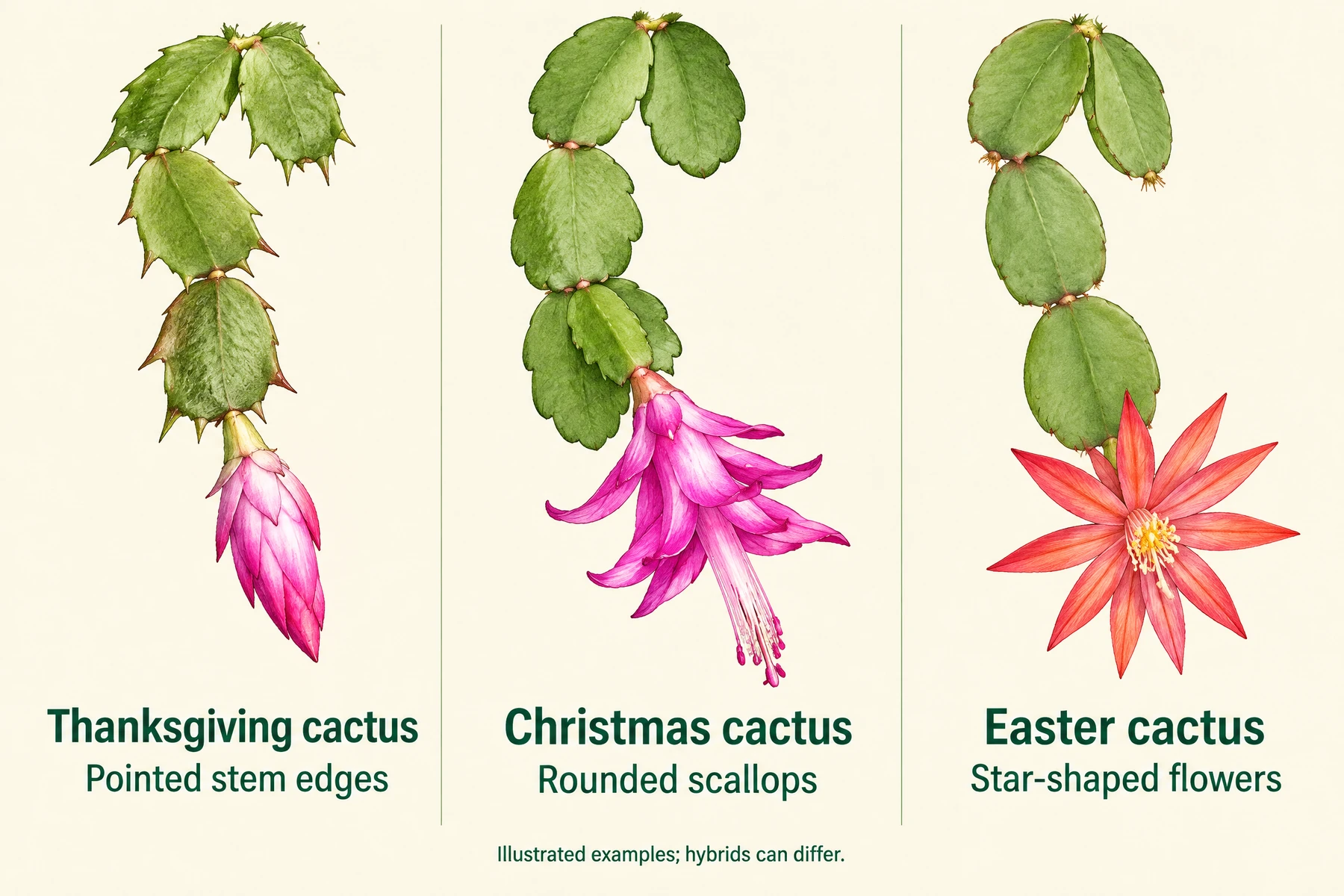
Illustrated traits are simplified for comparison; real hybrids may fall between them.
Where does Easter cactus fit?
Easter cactus belongs in the conversation because its rounded segments can resemble those of Christmas cactus. Its star-shaped flowers and spring flowering habit help distinguish it from the two winter-flowering types.
You may also find this Easter cactus listed as Hatiora gaertneri or Schlumbergera gaertneri in plant references. Those alternate names can explain why two care sheets use different labels for the same plant.
Its flowering regimen is different and more involved, so do not apply the Thanksgiving/Christmas fall routine below as an identical recipe for Easter cactus. For a spring display, follow Easter-specific guidance such as Iowa State's holiday cactus guide in the Sources section.
Which one is better for your holiday shelf?
Choose a Thanksgiving cactus if you enjoy earlier seasonal color. Its usual flowering tendency suits the beginning of the holiday season, and its pointed stem edges give it a distinctive look.
Choose a Christmas cactus if you prefer rounded, scalloped stems and a typically later display. It can be a lovely December or winter plant, although its name is not a promise that flowers will open on Christmas Day.
Choose an Easter cactus for a spring encore. Its star-shaped blooms make it a separate seasonal choice rather than a substitute for a winter holiday display.
If you want flowers soon, the plant's current buds are more useful than its holiday name. Look for firm, healthy-looking segments and buds that are still closed or just beginning to open. Neither cactus wins on name alone: a healthy, already-budded plant in the right spot is a more practical choice than a mislabeled plant bought for a promised date.
Give your display a stable shelf near bright, indirect light. A trailing plant can look lovely higher up, but keep it accessible for watering and away from heating vents, cold drafts, and glass that becomes very chilly. A decorative corner is not a good long-term home if it is too dim.
How to encourage Thanksgiving and Christmas cactus flowers
Thanksgiving and Christmas cacti respond to long nights and cooler fall conditions. For an established plant that has not set buds, this is a practical, conservative starting routine:
- Provide bright, indirect light during the day. Avoid intense direct sun that can stress or scorch the segments.
- Aim for roughly 14 hours of uninterrupted darkness each night for about six weeks. Evening lamps and other artificial light can interrupt that dark period. Keep the plant's location consistent rather than repeatedly shifting it between very different conditions.
- Aim for cool nights around 55–65°F. University of Illinois Extension pairs this with daytime temperatures around 65–70°F. Cool does not mean freezing: avoid cold drafts and sudden temperature changes.
- Continue careful watering. Do not try to force flowering by leaving the roots bone-dry or keeping the mix saturated.
The exact response depends on temperature, cultivar, and the plant's previous conditions. Some cultivars can set buds with shorter nights, but approximately 14 hours is a useful conservative target—not a guarantee.
Starting this routine in mid-November does not promise blooms by Thanksgiving or Christmas. Bud development and flowering take time. Think of it as supporting the plant's next flowering cycle, not meeting a holiday deadline.
Already seeing buds? Keep things steady
A cactus bought with buds has already begun the process. Do not put it through a new forcing routine simply because the calendar says fall. Instead, give it bright, indirect light, consistent temperatures, and careful watering while the buds develop and open.
Avoid repeatedly moving it, placing it beside a heater, or letting the potting mix dry out completely. Steady care is more helpful now than chasing an exact bloom date.
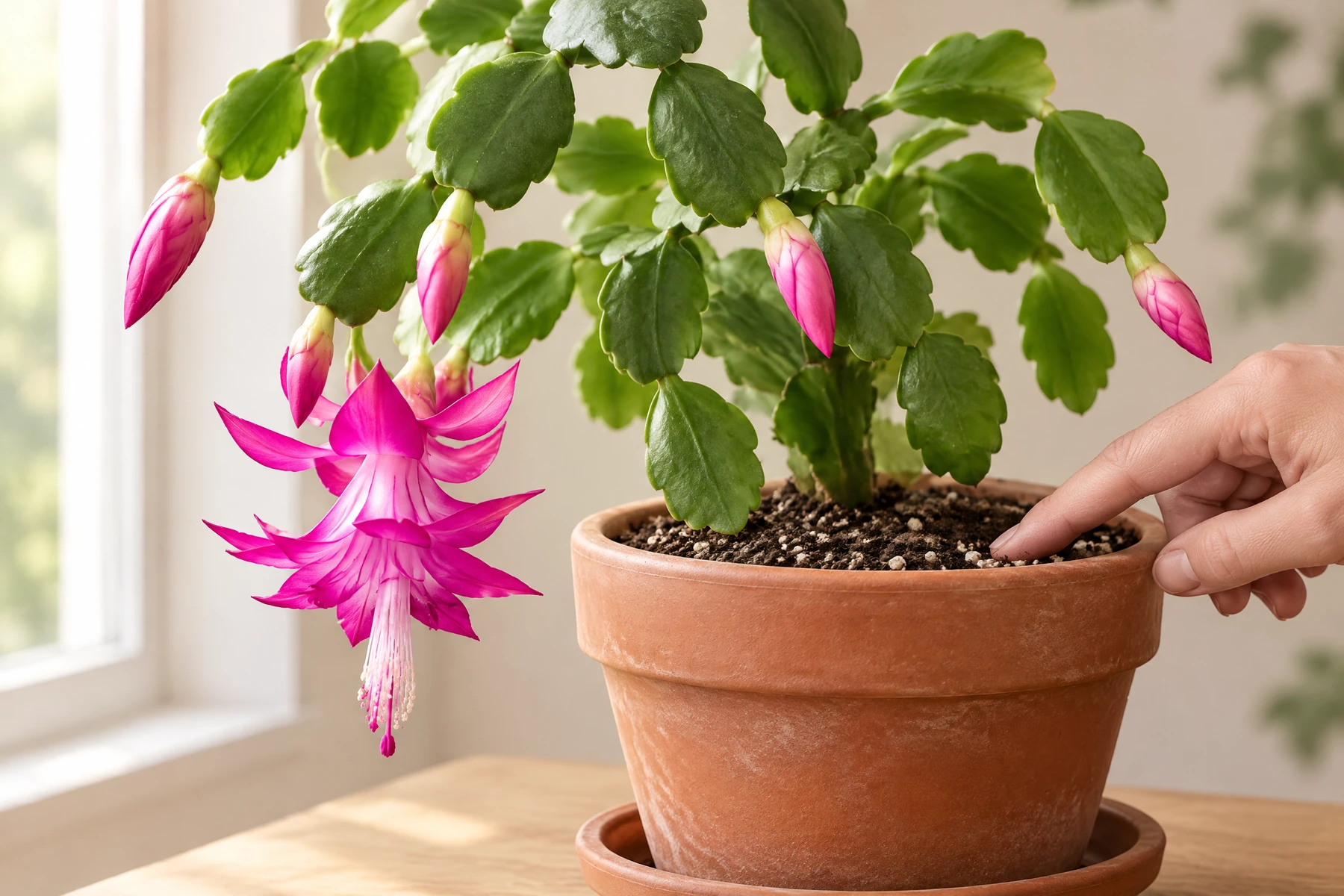
This care illustration shows a typical setting, not a diagnosis or a confirmed cultivar.
Everyday care: water, light, and drainage
Despite the word “cactus,” these are tropical forest plants, not desert cacti. They need drainage, but they should not be treated as plants that must stay completely dry for long stretches.
- Water according to the mix, not the calendar. Check the top layer before watering. When it has dried, water thoroughly and let excess water drain away. While the plant is budded or flowering, keep the mix lightly moist without making it waterlogged.
- Empty the saucer or decorative outer pot. Roots should not sit in standing water. A pot needs drainage holes, even if it sits inside a pretty holiday container.
- Keep the light bright and indirect. Gentle winter sun may be tolerated, but strong direct sun can stress the stems. The uninterrupted darkness used to encourage buds is a nighttime treatment, not a recommendation to keep the plant in dim light all day.
- Use a loose, well-draining potting mix. A dense mix that remains soggy makes watering harder to manage.
- Avoid hot, dry air. Keep the plant away from heating vents. A humidifier can help in a particularly dry home, but more humidity does not replace careful root-zone watering.
- After flowering, ease back slightly on watering. Let the mix dry a little more between waterings without allowing prolonged, complete dryness. If a healthy plant needs routine repotting, spring is a good time.
For a closer look at checking moisture and watering thoroughly, see the ultimate guide to watering houseplants.
Quick fixes for common problems
Buds are dropping
A change in temperature, light, or moisture can stress a budded plant. Cold drafts, heating vents, very dry mix, and overwatering are all worth checking.
Try this: Choose one bright spot with steady conditions, check moisture before watering, and empty any standing water. Avoid unnecessary moves while the buds develop. Some buds may still drop after transport; adding extra water automatically will not solve every cause.
It is not blooming
For Thanksgiving and Christmas types, evening light, warm nights, or an incomplete long-night period can interfere with bud formation. The plant's condition and cultivar also matter.
Try this: If it is healthy and not already budded, review the roughly six-week long-night routine above. Keep it bright during the day and protect its nighttime darkness. Do not assume an Easter cactus needs the same treatment, or that beginning late in the season will produce flowers on a particular holiday.
Stems look limp
Limp segments can result from too little water or roots that are struggling in wet conditions. Check the potting mix and drainage before reaching for the watering can.
If the mix is dry: Water thoroughly, let it drain, and watch whether the plant regains firmness. Avoid leaving it standing in the drained water.
If the mix is wet: Stop adding water, empty the outer pot or saucer, and check that drainage holes are clear. Wet mix combined with persistent limp or soft stems can signal root rot; do not simply keep waiting indefinitely for the pot to dry.
If softness persists or worsens, gently inspect the roots. Dark, mushy roots or a soft stem base need prompt attention. Remove rotted roots with clean tools and repot in fresh, well-draining mix if needed; significant decay may require help from a local nursery or extension service. Suspected rot is an exception to waiting until spring for routine repotting. An AI image suggestion alone cannot confirm the cause.
The seven common houseplant watering mistakes guide offers more help avoiding both drought stress and soggy pots.
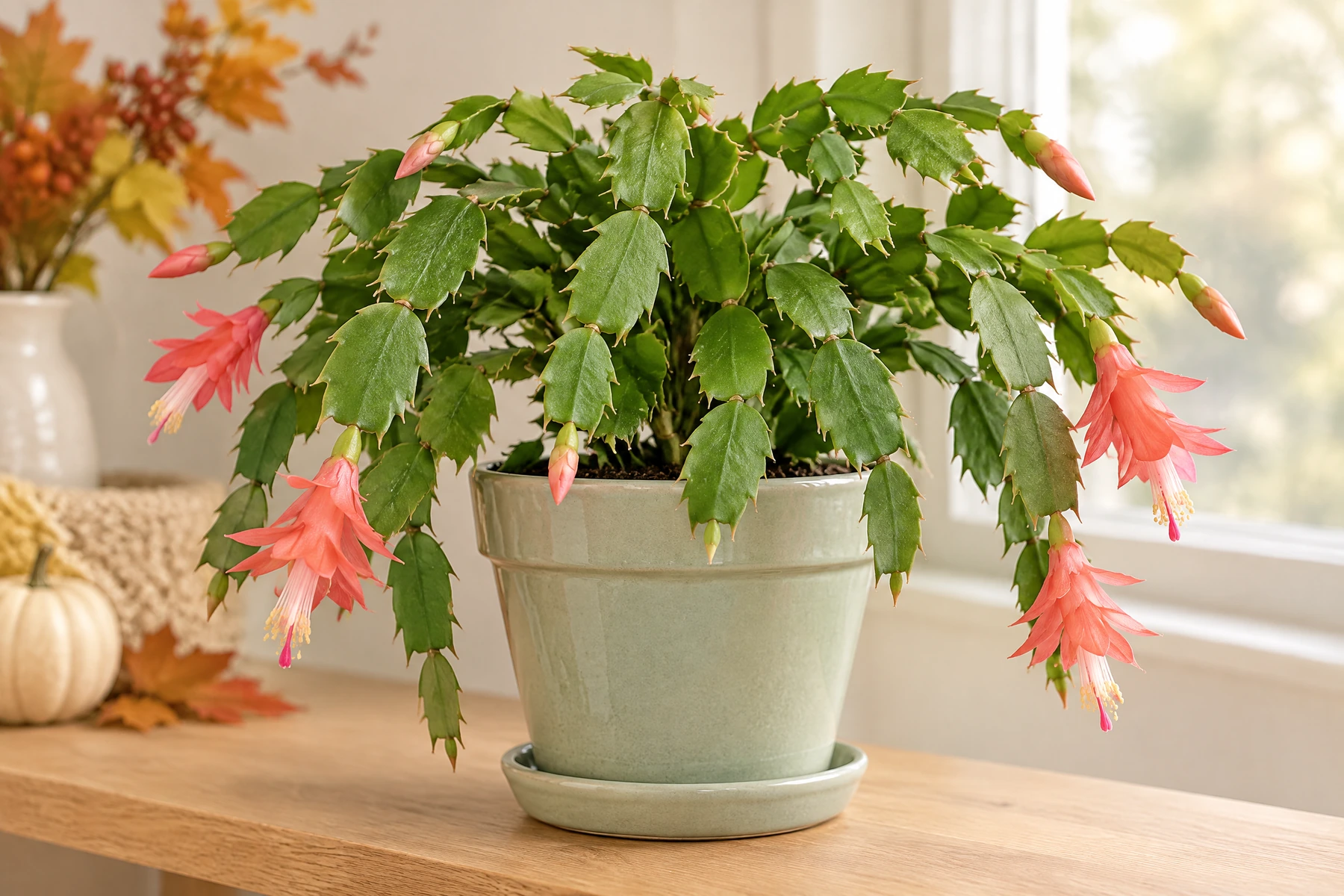
An illustrated Thanksgiving-type display; actual flowering dates depend on the individual plant and its growing conditions.
Want help identifying your holiday cactus?
Take clear photos of several mature stem segments, their edges, and any open flowers. Include the whole plant for context, then try the Botanical Wiz plant identification tool as a starting point for identification and care guidance.
Treat an AI result as a suggestion to compare with the plant's visible traits, not proof of a species, hybrid, or cultivar. For photo-taking tips and the limits of image-based identification, read the plant identification app guide. For current plans and access details, visit Botanical Wiz pricing.
Explore the Botanical Wiz store
If you would like to browse the store, use the link below. Choose any plant or supplies according to your own space and care needs; this guide does not promise particular inventory or holiday flowering.
Affiliate disclosure: This is an affiliate link. Botanical Wiz may earn a commission on eligible purchases at no extra cost to you.
Let the plant—not the label—guide your choice
Thanksgiving cactus usually offers earlier color, Christmas cactus typically flowers later, and Easter cactus brings a spring show. Their traits overlap enough that a label or a bloom date alone cannot settle every identification.
Choose the look you like, check the plant's health and buds, and give it bright, indirect light with careful watering. Once buds appear, steady conditions matter more than an exact date on the calendar. That is a good foundation for a holiday shelf you can enjoy well beyond the decorations.
Sources
Comments
0 comments
Sign in to join the conversation and share your plant knowledge.
Related Posts
Leggy Houseplants: Why Your Plant Is Stretching and How to Fix It
Long, sparse stems? Learn why houseplants stretch for light and how better lighting, careful pruning and healthy cuttings can encourage fuller new growth.
7 Mistakes You're Making When Watering Plants (and How to Fix Them)
Avoid seven common houseplant watering mistakes with plant-specific soil checks, good drainage, and a simple routine that adjusts to your home and the seasons.

Plant Identification App? Here's What You Should Know Before You Download One
Learn what photo-based plant identification can and cannot tell you, how to take a useful plant photo, and how to check AI suggestions before acting on them.